It’s the end of the first day of the Conscious Capitalism conference 2013. These are the guys who are standing up for something that the world at large probably considers a contradiction. How on earth can capitalism be conscious?
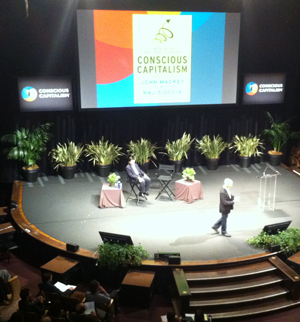 Featured were presenters long associated with Conscious Capitalism – people like Kip Tindell of The Container Store, John Mackey of Whole Foods, and Casey Sheahan of Patagonia.
They said some really great stuff.
And most of it was utterly unoriginal.
It was stuff you’ll read in a hundred articles, books or seminars.
Things like…
- Don’t do what you want, do what you love
- What makes the difference is connecting heart and mind
- Deriving happiness is about being part of something larger than yourself
- Make your decisions out of love not fear
- Meaning and purpose are the keys to doing things differently
But I’ve left the day feeling deeply and genuinely inspired. Why?
Trusting in love not lawyers
These are guys right at the top of truly global corporations. And when they say it’s all about purpose, they’re not spouting espousals. They’re simply telling us what they do.
And that’s what inspired me. Not the philosophy itself, (there was little that didn’t seem self evident to me), but that these guys are speaking from genuine integrity.
Integrity: To the degree you have integrity is to the degree that the gap between your inner values, dreams and ideology align with your outer world of action, behavior and embodiment.
Integrity for me is not just about keeping your word, or being a decent human being. It’s building—in your own consciousness—the structural integrity that comes from lessening the contradiction between what you believe and what you practice.
How often do you find a CEO of a global company start his conference presentation with a guided heart meditation? Or hear stories of $35 million deals being concluded not with signed legal fees, but a hug?
Not often. And that’s what I think makes these guys remarkable.
In fact, I would go so far as to say, that I believe it is the integrity of people like this that puts things like Occupy Wall Street or many non-profits to shame.
Integrity: the spirit of Conscious Business
That could be considered a bold claim to make!
So here’s why I made it. These men and women are putting their necks and their ideology on the line. Their dreams are not ideas in a book, they are dreams that are held accountable by their customers, their employees, their financiers, their suppliers and their communities.
There aren’t a lot of places to hide when you’re running a $12 billion corporation like John Mackey. If you’re faking, someone’s going to notice.
And that’s why I trust the integrity of this group of this group of remarkable people.
Without integrity, our dreams crumble. Without the solidity that comes from putting your ideology on the line, day in day out, ethical beliefs remain just that.
That integrity was oozing out of almost every speech made today.
And what is the central tenet of Conscious Capitalism? Not multi-stakeholder models, purpose driven enterprise or conscious leadership.
No, in the words of Raj Sisiodia today, the main tenet of Conscious Capitalism is love.
That’s an ethic I’m willing to put my integrity on the line for.
When I am going around the world being a meeting doctor, I will often ask bad meeting sufferers to complete the following sentences
“My meetings are…” and, “My meetings should be…”
The answers read like a textbook list of common meeting complaints (irrelevant, too long, too many, too little preparation, low value,) and an equally complete checklist of remedies. Very often participants know exactly what is wrong with their meeting and what to do about it. But meetings don’t improve. Knowledge clearly isn’t the problem.
So what’s going on?
The dangers of changing meetings
From my experience working with corporate clients, I’d say self-preservation is a key factor. People are scared they might save the meeting but lose their job.
Oh, it all seems easy enough in the safety of the training room. But in practise, out there on the front line of day-to-day business, challenging a more senior colleague to stop waffling or to turn up on time or turn off their email, can mean putting your job on the line. The corporate equivalent of telling a new partner they have bad breath or they’ve tucked their skirt into their tights.
When you mess with people’s meeting habits you are stepping into a minefield that’s got more unexploded bombs than the Hurt Locker.
Bad meetings are symptoms
I often think of meetings as the “acupressure points of business”. You press hard on the meeting and somewhere else the business yelps in pain. Meetings are seldom the problem, they are symptoms of the problem.
An indecisive meeting is usually the sign of an indecisive business. Maybe mistakes are punished, or the CEO is a control-freak. Or maybe consensus is king. I love the fact that meetings are fractals in this way. They’re such an elegant non-invasive way to assess an organisation’s general health and fitness. But once you know the system is all connected, you can understand why people are reluctant to start tinkering with a part of it.
Not ‘What’ to change but ‘How’ to change
“So, what do we do to change our meetings?†clients ask me around the world. It’s a good question but only a partial one. Knowing WHAT to do is essential. But not sufficient.
How you set about changing your meetings is equally, if not more important. This will dictate whether the culture absorbs or rejects the new rituals, also whether your campaign gains momentum or runs out of steam.
Here are some of my favourite ‘hows’.
1. Stop Talking about Meetings
Stop talking about meetings. First, the word is a real turn off. People’s eyes have rolled back in their head before you have finished your first sentence.
It’s easy to marginalise ‘meetings’ as a low value business issue, when actually they’re central.
In this post-industrial age of ours meetings are a vital part of how we build relationships, solve problems and generate value. Or they should be.
People who complain to me that ‘meetings are getting in the way of my work’ are missing the point. Meetings ARE your work and it’s time to do them better.
So, step one, stop talking about meetings and instead have a conversation about ‘how we work together’. How we meet is truly how we work.
2. Pick Your Battles
I see people leave our sessions (where we train people in the art of meetings) with piles of post its and notes. You know the ones that say, “I am really going to DO this. All of it.”
They try to change everything at once and within days they are deflated, distracted, defeated.
What I suggest instead is that people take out their diaries – go on, do it now – and circle one meeting in the next month which is a ‘high stakes’ event, that is, one where a real improvement will generate significant value and get people talking.
Concentrate on that.
And when it goes well let others ask you what you did differently. Much better if they are pulling information out of you, rather than you trying to push it into them.
3. Every meeting is Your Meeting
We all know the cautionary tale where a ten year old child is the only one brave enough to point out that the Emperor has No Clothes! Well, when it comes to meeting I want you to think you are that child.
I work at all levels of an organisation and everyone I talk to admits that meetings aren’t working. Yet, no-one does anything about it in the meetings themselves. It’s like walking round a heart attack victim on a city street. Everyone thinks it is someone else’s responsibility. It isn’t.
If you are in a meeting you are choosing to invest your time in that meeting. You may feel you are forced to be there or can’t say no. But, if you examine your inner workings you will see, you are in fact choosing to be there, choosing to spend your time there. And as an investor you have a duty to protect the value of your investment. That means speaking up if it’s being wasted. Even if it’s “an Emperor†doing the wasting.
Yes, how you ‘speak up’ is key – especially when senior folk are involved. But choose your words and your moment well and the most junior person can shift a whole organisation. I’ve seen it happen.
4. Air Cover
Sorry for the continuing military references in this blog. It’s probably because I have just seen the rather excellent military thriller Zero Dark Thirty. But also, in reality, a meeting change campaign needs to be approached a bit like a co-ordinated attack on the forces of Boredom, Waste and Outdated Convention.
Before I get involved in any program like that I make sure the leader (and extended leadership) give their team an explicit Licence to Operate. This includes providing active protection from reprimand (or worse) if someone causes upset to colleagues. It’s going to happen.
Change is upsetting. It never ceases to amaze me how hard people hold on to the mediocre (including meetings) when you threaten to improve them.
5. Give Up Sugar
Not literally, but remember the story about the father who brought his overweight son to see Ghandi hoping the Great Man would tell him to stop eating sugar. “Come back in three weeks†said Ghandi, which the father did and three weeks later Ghandi duly told the boy “stop eating sugarâ€. Puzzled, the father asked Ghandi why he couldn’t have said that three weeks ago. “Because three weeks agoâ€, answered Ghandi, “I was eating sugar tooâ€.
Which is a roundabout way to reminding us that people follow examples not posters. They will be inspired to change by what they see us do, not by what we say.
Don’t preach about new meeting habits until you have kicked the old ones yourself.
All the Best,
David
PS I am acutely conscious about the length of this blog and don’t want – like a bad meeting – to go on too long, but I can’t help offering another piece of counsel for anyone who wants to shift a meeting culture.
It’s one word – mischief. Meetings are a serious problem. If you want to see just how serious, you can check here (http://www.willtherebedonuts.com/count-the-cost-of-bad-meetings).
But you aren’t going to help matters by getting serious about them. The harder you push on conventions, the harder they’ll push back. You need to be crafty, playful. My book is full of suggestions about how to do this but, perhaps a couple of examples will suffice.
- If a meeting is dull, make it purposely duller. Use more impenetrable powerpoint slides. Deliberately slow things down and allow conversations to go nowhere. Do this until the most unaware person in the meeting begs for mercy. Now you can start to make changes
- One management board I work with keeps a stock of empty water bottles to throw at anyone who is caught looking at their laptop or blackberry. It makes meetings very lively
- And finally, you can do as one client did and publicly saw up and then burn the board room table! Let people know the meeting revolution has begun…
Guest Post by David Pearl.
David is a good friend of Waking Up the Workplace, and author of the fabulous book “Will There be Donuts?: Start a Business Revolution One Meeting at a Time.” You can find his blog here.
If you missed part 1 of this blog, you can find it here (probably best to start there if you just stumbled across this article).
OK, onto the final 3 tropical meeting problems…
Problem #4 – Arguing over the Agenda
Time is probably precious to you – you don’t have enough of it. So when this happens to you, it probably frustrates the hell out of you…
“We come into the meeting with lots of important things to resolve, but just agreeing on what’s on the agenda, and in what order we address them takes half the actual meeting!”
 There are a couple of reasons why this problem occurs in meetings.
A common one is that when you start trying to agree on the agenda, this happens… Someone brings up an agenda point, and then immediately starts discussing it. You may think that’s the obvious and efficient way to go about it. It’s not! Not only annoying, but horribly inefficient.
The second reason is probably even more problematic. If you don’t have a reliable habit of getting through all your agenda points in the meeting, then there’s going to be some serious political jostling from people to get their items high up the list.
The result? Building the agenda becomes an exercise in ‘who has the most outspoken ego’. Fun. So how do you work with this?
What you can do to address this problem
Simple (but not always easy). You put in place a very rigorous agenda building process. here’s the best one we know.
- Don’t build the agenda in advance – this guarantees everything on there is current and relevant. Yes, this can be scary! But it doesn’t mean you can’t think about agenda items in advance, or don’t prepare. It just means build the agenda on the spot.
- Go point by point – move around the circle and one by one offer points to add to the agenda. Whatever you do, don’t start explaining the points or discussing them, just compile a list of labels. So long as the person bringing in the point knows what it means, it’s fine. You’re finished when no-one has any more points. If someone wants to talk about sales, and someone else wants to talk about sales, too, list it twice. They may be very different points, requiring a different decision or action.
- Agree to get through all of them – and set a time limit to do so. If you do this, then it immediately resolves the issue of political manoeuvring around certain topics, since everyone knows everything gets covered.
Simple. If building the actual agenda takes more than 2 or 3 minutes then you’re probably doing something wrong. Still find it hard to get through all the points on the agenda? Never fear, that’s up next…
Problem #5 – Meaningless Meeting Minutes
 There’s nothing that’s going to shine a brighter light on the effectiveness of your meetings than what happens afterwards with the minutes. Ever have this experience?…
“We come out of the meeting with 10 pages of minutes that get emailed around, but no-one looks at them and nothing gets followed up on.”
Maybe you agree on what ‘we’ need to do on a particular item, but then nothing gets done. Maybe you never even get to solutions, and manifest problem #4.
Whatever the cause, it’s a frustrating thing to spend time meeting with people to resolve things, but find the following week that nothing’s been done to move things forward.
In a way, this says more about the cultural habits outside a meeting than in it, but it also identifies a key component of good meeting practice: clarifying and capturing next-actions.
What you can do to address this problem
There are really effective ways to use next-actions, and there are inept ways. Here’s a process that should banish meaningless meeting minutes forever!
- One item at a time – don’t ever mix up or combine agenda items. Go through them in order, one by one, and use the person that brought up the agenda point as you’re ‘sensor’ for when you’re done.
- A brief discussion – you may need to talk about the item to understand what the problem is, or you may not. But either way as soon as responsibly possible move on and…
- Ask ‘what do you need’ – you can discuss problems for near on eternity, but the key is finding the physical next-action to take it forward, and not all the things that would resolve this forever, theoretically. And make sure you’re asking the person who brought up the addenda point specifically, and not the entire room (that leads to more discussion).
- Start next-actions with a verb – so it’s clear what the outcome is, that’s measurable. For example “Powerpoint Presentation” is a really bad next action. You may know what it means when you write it down, but in the tumult of busyness you quickly forget. Instead phrase it in a way that is physically measurable, for example “Create and email Powerpoint Presentation on meeting practices to Jeff.â€
- Have one name next to each next action – so that there’s no confusion over who is accountable for it. And always have a name!
Do all this and you’re making it pretty hard for agreed tasks and actions to fall between the cracks. No more “I thought we agreed to get this done, what happened?”.
Problem #6 – Ego Jousting
This one is a real productivity killer and can manifest in all kinds of ways, but you’ll probably recognize it as something like…
“It feels like most of us are just here to provide an audience for today’s round of political infighting by the same two or three people.”
 No matter the meeting topic, the same people talk about the same old gripes, and try and ram the same old story down the same old throats.
The result? People start to feel unsafe – fast. It’s hard to bring anything in as it’s seen as a threat to the jousting competition. So you end up as the invisible schmuck in the corner, never seen and never heard. Great way to feel useful!
The bad news is this one is normally a sign of a pretty dysfunctional organisational culture that has nothing to do with the meeting itself. The good news? There is something you can do to calm the disease.
What you can do to address this problem
Get a meeting facilitator. Not always easy to do, but it’s the only real way of addressing this problem without doing major cultural change work. And if you do it, you should see results fast. So, how does it work?
- Get agreement from all the meeting participants to use a facilitator – maybe you need to do it on a trial basis at first, but just do what you need to do to get the green light. It could be someone who’s already a regular meeting participant, or someone from the outside (less politically loaded).
- Agree the process that you want facilitated – keep it simple, for example, the 4 steps of check-in, agenda building, processing agenda items into next-actions and check-out.
- Guard the process – the job of the facilitator is not to police people and control them, but to guard the process. Anytime the meeting veers of track, gently bring it back to the topic at hand. It’s not personal.
- Invite feedback – have the facilitator ask for feedback at the end of the meeting. What worked, what didn’t, how did they feel about having it facilitated in general?
A good facilitator is worth their weight in gold, but even a semi-competent one is probably going to make a big difference to ego jousting. And the more you get in the habit of sticking to the structure with the facilitator’s help, the more people will start to facilitate themselves.
These solutions will help you have great meetings
But, don’t try them all out at once! Even if you’re meetings suck so hard you’re desperate to make sweeping changes, our advice would be do it bit by bit.
Because some people can be resistant to change! Try out one or two of these suggestions and see how it goes.
The proof is in the doing, and these solutions do work.
And take a moment to leave a comment below and tell us what happens when you try these solutions out in your meetings!
Meetings. The cornerstone of ‘collectively getting stuff done’ in business.
You gather as a team, whip through all the stuff that’s important, feel great about the work you’re all doing, and come out feeling energized and inspired!
What’s that? Your meetings don’t look like this!?
 Oh, are your meetings more often…
- A confirmation that no one really knows what they’re supposed to be doing
- A source of more conflict and confusion than you started with
- Deathly boring events that sap your energy and motivation
- A barrier to actually getting the work done
Don’t worry, you’re probably having the same experience as 99% of people in business – that meetings suck!
Good news! There are some easy steps you can take to overcome difficult meetings
Having conscious and effective meetings is really important! Not only because it’s going to feel like less of a pain in the ass, but because it means…
- Your meetings make powerful progress for the whole organisation
- You get energy and motivation from meetings, rather than have it taken away
- You create a culture of team-work and collaboration
- You get a sense of clarity and relaxation, knowing that all the bases are covered
Sound good? Awesome. How to do that is exactly what we’ve drawn up for you here.
We’ve been practicing these approaches and teaching them to businesses for several years now, and so you can trust us when we say—they work!
Now of course, these are some pretty complex problems that can have a whole host of underlying issues. So the solutions we’re proposing aren’t the only ones, but…they are effective ones.
If you can follow even half these steps you’ll see a huge change in the effectiveness of your meetings (while having a bit more fun, and a feeling lot less anguish).
OK, onto the most typical problems in meetings.
Problem #1 – Why on Earth Am I Even Here!?
 You know you’re beset by this problem when you arrive at a meeting and think to yourself something like…
“What am I doing here? Well, I guess because I found this meeting in my calendar, but I have no clue what we’re supposed to talk about.”
This is like the problem of people randomly carbon-copying (CC’ing) everyone and his brother into emails. Only worse.
Because these random-type meetings actually take away from your valuable time and energy. And then proceed to reliably achieve the outcomes no-one actually wanted in the first place.
Not fun. And a big strain on the larger resources of the organization. Bad news all around. So what’s to be done?
What you can do to address this problem
The easiest way to address this problem? Two words: meeting invitation.
If you send a clear and concise invitation, you’re probably going to clear up this problem pretty fast. So how do you do it?
Make sure you send a very clear and explicit invitation at least a few days in advance. What do you want to include? At least the following…
- Title – make this as accurate and descriptive as you can – this is what’s going to show up in people’s calendars!
- Purpose – what’s the goal of the meeting?
- Trigger – why is this meeting important today or this week? (Even — or especially — if it is a recurring meeting.)
- Outcome – what would we need to achieve for this meeting to be a success?
- Invitees – who needs to be there? (And if it’s not totally clear already, include your assumption for why they should be there!)
- Practicalities – when and where is it, and how long will it last?
- Preparation – are there any specific actions that people need to take before the meeting? (Or stuff to bring with them)
Sending an invitation that includes this information is going to have one very big effect.
It’s going to create very clear distinctions between what the meeting is and isn’t about, and what is included and not included.
It helps everyone get on the same page, before you even walk into the room, and allows everyone to make an informed assessment about whether they actually need to be there, or whether they just got casually CC’d on the email.
Problem #2 – Is this a Meeting or a Water-cooler Chat!?
The feeling of total bewilderment…was that a meeting!? You know you’re a victim of this problem when you experience something like…
“We more or less stumble into, through, and out of the meeting without anyone ever making a clear and conscious choice about what we’re talking about, what we’re trying to accomplish, and when we’re done.”
 Ouch. What a mess. And, unfortunately, a mess that is endemic in business meetings.
If you have a lot of meetings like this it probably feels like a big waste of time, leaving you feeling frustrated and out of control. Which of course does wonders for your motivation!
How do you get out of this mess!?
What you can do to address this problem
The problem here is boundaries. No one is sure what’s going on or when the meeting has succeeded (i.e. finished).
So the key here is clearly and consistently demarcating the beginning, middle, and end of the meeting, so you know where you are, and why.
The simplest way of solving this is using what are known as “check-ins” and “check-outs”. So how do you do this?
- Clearly mark the start of the meeting – this could be the meeting organiser summarizing the purpose and agenda, or it could be as simple as hitting a bell or playing your favorite motivational meeting tune!
- Check-in – everyone briefly (!) shares how they’re showing up in the moment, and what they’d like to mention or let go of so they can be fully present. No reactions or discussion, just one by one. There’s something about hearing everyone’s voice to really open the conversation space, and you may get some relevant information like someone feeling stressed out or suffering from a headache.
- Have the meeting – there are a variety of specific middle parts you can add to the structure, which we’ll cover later, but for now, think of this as the meat in the sandwich
- Check-out – give everyone another minute to share their personal experience of the meeting, and how it was for them. Again, no discussion, just individual space to talk. If you want, you can ask people what went well and what didn’t go as well, so you can get immediate feedback on your meeting!
- Clearly mark the end of the meeting – again, this could be something like a bell, or a verbal closing: “thanks everyone, the meeting is now done, see you next time.” Getting up is another great way to physically and energetically close the meeting. Don’t hang around talking, since that starts to blur the line between being in and out of the meeting again.
This may sound simple, but having a clear beginning and end, and giving everyone the opportunity to check-in and check-out often has a remarkable effect on this kind of problem.
And the more you get into a habit of doing this, the more everyone is going to start facilitating clear boundaries themselves, which creates a really clear and efficient culture, inside and outside of meetings. Good news!
Problem #3 – Death by Discussion
 There’s nothing worse than being in a meeting and dying a slow and painful death from endless discussion. You know the score…
“All we do is talk, the meeting is just this huge discussion where everyone shares their opinion, and nothing moves forward!”
Are we here to get stuff done, or are we here to have a nice chat and share our feelings and perspectives?
Our friend from HolacracyOne Tom Thomison makes a great point: “Most companies die of indigestion, not starvation.” And endless discussions are definitely a symptom of organization indigestion!
Trying to constantly make group decisions is going to slow you down to a crawling pace, which can be pretty frustrating. So what’s the answer?
What you can do to address this problem
There are two main things you can do to avoid this problem. The first one is pretty straightforward. The second takes some more effort.
- Get shared understanding on the intended outcome – maybe the meeting actually needs a loose and unstructured discussion. Or maybe it needs a really tight structure to address specific issues. Get clear on the intended outcome and you avoid muddled expectations, and get everyone on the same page so they can show up fully and powerfully.
- Avoid consensus hunting – unless you have clear and defined roles and authority you’re not going to know who ‘owns’ a particular chunk of work, and so you’re going to try and get group consensus on every issue. Which is a sure-fire way to create endless discussion and organization indigestion! So make sure you know who is leading and “accountable” for a specific project or task area, and you can avoid this. Preferably do this outside of the meeting, but if you don’t have that kind of clarity, have a roles meeting. Whatever you do, don’t combine a meeting about roles and authority with one on operational issues – you’ll get neither done well!
If you put these two solutions in place you’re going to give your organisational stomach some much needed digestion aids, and get everyone pulling in the same direction.
If you’re involved in business at all, you probably have ideas about new stuff to work on.
 You have a flash of inspiration for a new business while sitting on the toilet, or you get a child-like giddy feeling thinking about this new workshop or product you want to design.
Whatever the source of your ideas, the next step along the road is usually to write up a plan. You can then prove how great the idea is, and make sure the strategy is water tight.
Sounds smart.
Usually isn’t.
Most business plans suck. Not because they don’t include all those stimulating and exciting elements like SWOT analyses and risk assessments. But because they’re pretending to be something they’re not.
Writing a business plan is an exercise in making big-ass assumptions
Jason Fried makes this point beautifully in his (very short) article Let’s call business plans what they are: guesses (longer version in his wonderful book ReWork).
Basically, Fried’s point is that we think business plans are real and robust, when they’re not. They’re guesses, and the sooner we realize that, the sooner we can get to work, dream and build, rather than think we’ve got it all ultimately planned out.
Not only are most business plans not actual plans (but guesses), but they can really stifle the creative juice you had when you first thought of the idea.
You spend long, tedious hours filling in all the proper sections, and meeting all the right conventions, and by the end you’d rather clean your toilet (the one you had the original idea while sitting on) than think about it ever again. Nice job.
So, what’s the alternative?
Use your business plan as a creative exploration
An actual business plan is based on something you dreamed up in your head, it’s full of assumptions and guesses, is not robust in the slightest, and will probably bear little resemblance to any real thing to come out of it.
 So, let go of the idea that it’s a plan, and instead use it for a different purpose.
Ditch the 20-page megalith and use your plan as a creative exercise. Explore your idea, follow your thought threads, bookmark open questions and honour your excitement about the idea!
Basically, I’m advocating you use a ‘plan’ to start a conversation about your idea (either with your colleagues or yourself).
Most of the plans I write for Waking Up the Workplace are (as my colleagues can testify to) pretty unconventional. They have often been…
- Written in the form of a letter – complete with ‘hey guys’ and ‘all the best’ at the start and end, and usually involving some story or other that started me off
- Full of holes – “I think this could be a really cool thing to do but I have no idea how we’d do it, which I’m ok with right now”
- Self-critical – “To be honest I’m not crazy about this bit, but it’s something to work from at least”
- Unusual in their stated goals – including such specifics as: ‘To enjoy the shi*t out of the experience.’ ‘To trust in God.’ ‘To promote the pants off it.’
Now I’m not necessarily advocating you follow all such (un)conventions. My point is that if the experience of writing the plan isn’t a lot of fun, you’re probably not doing it right.
5 ideas for you to find the fun in (not) planning
So, if you want to try writing your business plans in a new way that’s more enjoyable, and more useful, here are some ideas for you to try out.
These are in no way comprehensive, or scientifically proven, but hopefully they stimulate you to have some fun…
- 1 – Try writing in the first person  – business plans are ideas, and utterly opinionated. When you don’t write in the 3rd person and pretend they’re objective, it allows you to be transparent in your human perspectives.
- 2 – Include the phrase ‘not specified’ – these things are all based on assumptions and guesses, so you don’t need to have answers to everything. Allow it to have holes in, and just be honest about where they are (as far as you can tell).
- 3 – Don’t worry about a ‘proper’ structure – just write it as your thoughts come through…stream of consciousness, and then go back and tidy it up afterwards if you need to.
- 4 – Make it ‘good enough’ – so you can have a conversation about it and start trying it out in practice. So long as it’s not going to do any damage as far as you can tell, it’s fine.
- 5 – Once it’s done, don’t revise it – it’s not a book that you need to publish, it’s a conversation starter, so don’t make a v2.0, put it into action! If you have more ideas or adjustments along the way, just write a new follow up which builds on the first.
The bottom line is do whatever works for you to ensure it doesn’t stifle your creativity. Business is about trying stuff out and seeing what happens. If you can practice that in your business planning, then you’re off to a good start.
P.S. If you’re doubting the usefulness of the business plan paradigm in general, let me just say “I’m with you”!
Look out for a future blog where I’m going to explore the whole issue in a more comprehensive way and suggest approaches that actually replace the whole need for a business plan.
If there is one issue that seems to be a sticking point in doing business more consciously, it’s making money.
How can you claim to be ethical in business if you’re making a huge amount of money at the expense of others!?
That’s the common critique right? Well, I think it’s such a central issue to the growth of Conscious Business that I’ve decided to open the money can, and see how the worms are doing.
This blog is particularly written for you if…
- You are committed to doing good in the world through business, but you either struggle to make money, or you have ethical reservations about doing so.
But whatever your relationship to money, I hope you’re stimulated…
What’s the right way to think about money?
Read the liberal press these days, and your likely to find more and more vehement articles about the damage Wall Street and the corporations are doing to our world.
Read the conservative press, and you’ll probably find just as much vehemence, but instead about the suffocation that socialist policies are having on the growth of business and the economy.
Who’s right?
Well, I’m going to totally duck that rather loaded question, and try and answer a different one instead.
How can we define money so that it helps us to consciously evolve the business world, rather than dismantle it?
Because unless you’re going to try and extract yourself somehow from current society, you’re going to have to deal with money – it’s here to stay! And there are some pretty contradictory beliefs around money. In my opinion, some of them are pretty toxic!
Here’s one I grew up with…
Money is basically evil, and the root of most of the world’s problems. We need to abolish money and capitalism and just love each other more.
Nice sentiment, and one that’s served me and my bank balance very well for many years.
Money is not evil, it’s energy
OK, so time to put my cards on the table. Here’s my view…
The purpose of business is not to maximize profit. And neither is it to limit your potential profiteering because of some idea about money being the tool of the corrupt.
So how do we reconcile this?
For me, business is basically about idealism. It’s about recognizing that we have dreams of a different world, and using business as the most powerful vehicle around for manifesting those dreams.
A business is about building something that doesn’t yet exist, that you believe is needed, and that you care about.
Think of it like a car. Your starting from here, and you want to drive down the road to manifesting your visions of what is possible.
 And money? Money is the thing that feeds that vehicle. It’s the energy. Or more specifically in this metaphor, the fuel.
The purpose of a car is not to have fuel, it’s to move from one place to another. But it better have some fuel otherwise it’s not going to get very far! A car without fuel is pretty close to totally and utterly useless.
Likewise, a business without money is a pretty impotent business. You’re not going to be able to build your dreams very far without money. But the purpose of the vehicle is not to have lots of fuel, it’s to make a journey.
Are you fueling your vehicle generously?
So, how’s your fuel source doing? Flowing abundantly or dribbling in fits and starts?
There’s no doubt that making money and doing good often make uneasy bedfellows. It’s a sticky topic with huge implications.
But putting aside that inconvenient fact for a second, I want to offer you an inquiry exercise that can help you to…
- Explore your own beliefs around money
- Check in on your own ethics in business
- Have a bit of fun
Ideally you would print out these questions and grab 10 minutes to sit quietly and write out your responses in a notebook. But cracking open a blank page on your word processor will work fine too.
OK, here you go, complete these sentences…
- As I check in with my own integrity, the reason I genuinely believe my work makes the world a better place is…
- If I had more fuel flowing into my work vehicle (more money), the things I would be able to do that I can’t do right now are…
- If I think of a monthly earning figure that would feel fair and rewarding to me, it would be…
- If I imagine earning triple that figure every month, I notice I feel…
- Noticing those feelings, and as I read back over my response to question 1, I now notice…
- One big belief I have about money is…
- As I notice I have that belief I feel…
- If there was a different way I’d love to see money instead, it would be…
Want to dive into this topic further?
There is a LOT of stuff out there on this topic of course. A few things I’d personally recommend…
- Curious to hear a high level and human description of economics that promotes Conscious Business? Check out this Fred Kofman podcast from Sounds True.
- Want really practical resources on money and the ethics of earning it? Take a look at the work of Brent Kessel.
- Interested in a spiritual and philosophical exploration of the ethics of money and dharma? Check out Integral theorist Ken Wilber’s Right Bucks article.
And as always, I’m interested to hear what’s helped you with your relationship to money. And what happened for you when you did the exercise?
Leave your comments below…